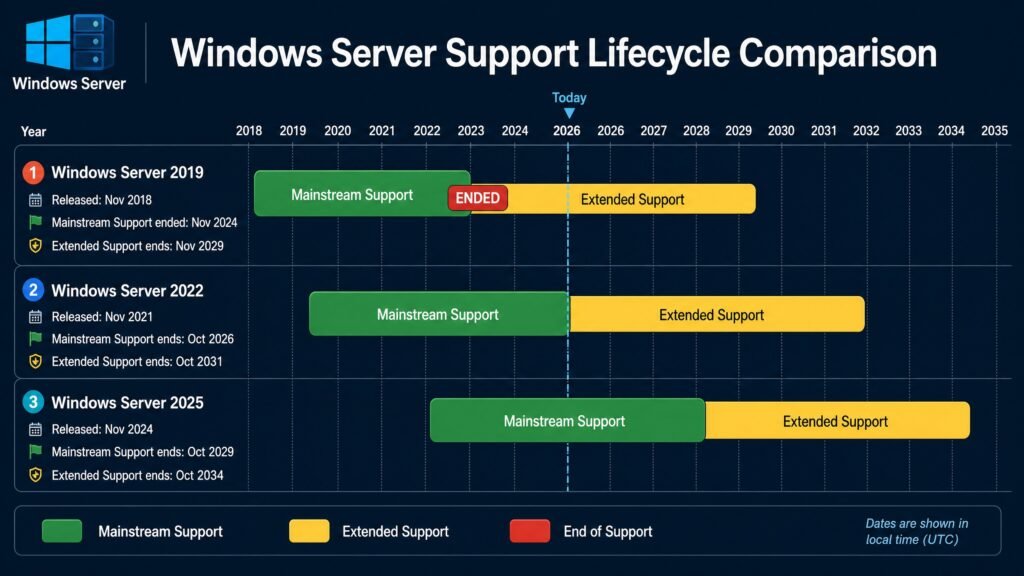
The windows server 2019 vs 2022 vs 2025 decision is settled by the support calendar before it is settled by features. Server 2019 has security updates until January 2029, Server 2022 until October 2031, and Server 2025 until around October 2034. For a machine you plan to install once and forget about, those three dates decide more than any feature list.
Nobody impulse-buys Windows Server. The box will run for five to ten years, other systems will depend on it, and “which generation?” is really a question about how long you can go before touching it again. This guide covers the calendar, the licensing traps that cost more than the licence itself, and the honest cases where the older version is still the right answer.
Table of Contents
- The verdict up front
- The support calendar — the real comparison
- What each generation actually added
- Security: the honest argument for moving forward
- Licensing: cores, editions and CALs
- Hardware requirements and the TPM check
- Virtualisation: where the version choice bites
- Upgrade paths compared
- Server Core or Desktop Experience?
- Which one fits your situation
- What to check before you pay
- FAQ
Windows Server 2019 vs 2022 vs 2025: the verdict up front
Buying today for a new deployment: Windows Server 2025, and it is not close. Newest platform, longest runway, no migration on the horizon.
Windows Server 2022 remains a sensible buy for compatibility-sensitive environments and tighter budgets — five years of patches left and the longest third-party testing track record.
Windows Server 2019 is now a specific-reasons purchase: a legacy application certified only for it, or matching an existing fleet. Not for new projects.
That is the whole windows server 2019 vs 2022 vs 2025 answer in three lines. Everything below is the reasoning, and the licensing detail that catches first-time buyers.
Windows Server 2019 vs 2022 vs 2025: the support calendar
| Generation | Mainstream support ends | Extended support (security updates) ends |
|---|---|---|
| Windows Server 2019 | Ended 9 January 2024 | 9 January 2029 |
| Windows Server 2022 | 13 October 2026 | 14 October 2031 |
| Windows Server 2025 | Around October 2029 | Around October 2034 |
Read the windows server 2019 vs 2022 vs 2025 table the way an administrator does. A new deployment on 2019 buys under three years of patches. On 2022, about five. On 2025, eight.
Two notes matter when reading windows server 2019 vs 2022 vs 2025 dates. Mainstream support includes new features and non-security fixes; extended support is security patches only, delivered at no extra cost. And Server 2022 drops into extended support in October 2026 — nothing breaks, but if you were waiting on a feature, that wait becomes permanent.
All three of windows server 2019 vs 2022 vs 2025 follow the same fixed lifecycle: roughly five years mainstream plus five years extended. Our dedicated guide to Windows Server 2019 end of life covers that timeline in full, including why the truly urgent deadline in most estates is Server 2016 in January 2027.
What each generation actually added
Feature-by-feature is the least useful way to settle windows server 2019 vs 2022 vs 2025, but you should know what you are choosing between. Here is what each generation in windows server 2019 vs 2022 vs 2025 actually brought.
Windows Server 2019: the dependable baseline
Windows Admin Center into the mainstream, solid Hyper-V, Storage Spaces Direct improvements, and rock-stable Active Directory. It runs half the small-business world quietly to this day, which is exactly why it is still sold.
Windows Server 2022: the security generation
The theme was hardening. Secured-core server (firmware-level protection), TLS 1.3 by default, AES-256 encryption for SMB, HTTPS-secured file sharing, and nested virtualisation on AMD processors as well as Intel. The “nothing exotic, everything solid” choice.
Windows Server 2025: the modernisation generation
The first genuinely big platform step in years. A new Active Directory functional level — the first since 2016 — with better scalability and encryption for directory traffic. Large NVMe storage performance gains. SMB over QUIC across editions for VPN-less secure file access. GPU partitioning so several virtual machines can share one physical GPU. And hotpatching: many security updates applied to a running server without a reboot, now an optional subscription.
Hotpatching deserves the attention. Reboots are the tax on server patching — they need a window, a warning and, on clustered systems, sequencing. The result is that patches get deferred, not through negligence but through the difficulty of finding a window that suits everybody. Removing the reboot turns patching into something you do on schedule rather than negotiate.
Security: the honest argument for moving forward
Strip the marketing away from windows server 2019 vs 2022 vs 2025 and security is the real reason to move. The workloads most organisations run — file shares, print, Active Directory, a line-of-business application, a few virtual machines — ran fine on 2019 and still do. What changed underneath them is the threat model.
Secured-core server, introduced in 2022, brings hardware-rooted protection into the platform. It needs TPM 2.0 and Secure Boot, and enables virtualisation-based security, hypervisor-protected code integrity and boot integrity checking.
Server 2025 continues in that direction: SMB signing required by default, protection against brute-force and downgrade attacks on file servers, and Delegated Managed Service Accounts for the service-account credential problem.
The honest counterweight
Every one of those improvements is real. None of them helps a server that is patched late, exposed directly to the internet, or protected by a password three former employees know.
The most common actual cause of a compromised Windows Server is not a missing platform feature. It is Remote Desktop published straight to the internet, an unpatched application, a service account whose password never changes, or a backup nobody has tested restoring. A well-run 2019 environment is safer than a neglected 2025 one, and it is not close.
So the honest order is: patch on schedule, get Remote Desktop behind a gateway or VPN, test your restores, remove accounts that should not exist — then upgrade the platform. Doing the last one first buys less than it appears to.
Where the windows server 2019 vs 2022 vs 2025 choice genuinely becomes the issue is when support ends. After that date, newly discovered vulnerabilities stay open permanently and no configuration discipline compensates.
Windows Server 2019 vs 2022 vs 2025 licensing: cores, editions, CALs
This is where windows server 2019 vs 2022 vs 2025 comparisons usually stop short, and where expensive mistakes happen. The licensing model is identical across windows server 2019 vs 2022 vs 2025, so this part does not change with your choice.
If any of those servers will host Remote Desktop sessions, the CAL version has to move with the server version too. Our guide to RDS CALs covers that rule and what happens when the grace period ends.
Licences are counted by cores, not machines
Three rules govern it:
- Every physical core in the server must be licensed.
- Each physical processor must be licensed for a minimum of eight cores, even if it has fewer.
- Each server must be licensed for a minimum of sixteen cores in total, even if it has fewer.
The practical effect: a single-processor machine with four cores still needs a sixteen-core licence. A dual-processor machine with ten cores each needs twenty cores licensed. Work this out before you buy hardware — two processors with fewer cores each can license more expensively than one processor with more.
Standard versus Datacenter
| Capability | Standard | Datacenter |
|---|---|---|
| Licensed by physical cores | Yes | Yes |
| Virtual machine rights | Two per licensed host | Unlimited on the host |
| File, print, web, directory roles | Yes | Yes |
| Hyper-V host role | Yes | Yes |
| Storage Spaces Direct | No | Yes |
| Storage Replica, full capability | No | Yes |
| Software Defined Networking | No | Yes |
| Shielded virtual machines | No | Yes |
Across windows server 2019 vs 2022 vs 2025 the edition decision is pure arithmetic on virtual machines. One or two guests: Standard. You can stack Standard licences — licensing the same host twice grants four guests — but there is a crossover point, usually around ten to fourteen guests per host, where Datacenter is both cheaper and simpler. Guessing this wrong is the most common licensing error we see.
Linux guests need no Windows Server licence at all, which occasionally changes the maths. A host running two Windows guests and six Linux guests needs Standard, not Datacenter.
Client Access Licences — the part people forget
The server licence permits the software to run. It does not permit anyone to connect. Connections need Client Access Licences, purchased separately.
Per User covers one named person on any number of devices. Per Device covers one machine used by any number of people — right for shift work. Most offices are cheaper Per User; warehouses and clinical settings are often cheaper Per Device.
Two further points. CALs must match or exceed the server version — a 2019 CAL does not permit a connection to a 2022 or 2025 server, so a server upgrade means a CAL upgrade, and forgetting that is how a budget doubles late. And Remote Desktop Services needs its own additional licence on top.
Windows Server 2019 vs 2022 vs 2025: hardware and the TPM check
Before settling windows server 2019 vs 2022 vs 2025, check whether the hardware you already own can actually use the newer ones. Published minimums describe what will boot, not what will work.
| Component | Published minimum | Realistic for production |
|---|---|---|
| Processor | 1.4 GHz 64-bit x64 | Current-generation server CPU with cores for your guests |
| Memory | 512 MB Core / 2 GB Desktop | 16 GB for a small file or directory server; far more for a host |
| Storage | 32 GB | SSD or NVMe system volume plus separate data volumes |
| TPM 2.0 | Not required to install | Required for secured-core and BitLocker |
| UEFI + Secure Boot | Not required to install | Required for secured-core; worth enabling regardless |
| Network | Gigabit ethernet | Redundant links on anything people depend on |
The row that catches people is TPM and Secure Boot. A server from 2016 or earlier frequently has neither. It will still install 2022 or 2025 — but cannot use the secured-core protections that are the main reason to move.
Check before you buy licences. Run tpm.msc for the TPM version, and msinfo32 to confirm BIOS mode reads UEFI and Secure Boot reads On.
Virtualisation: where the version choice bites
For many buyers the server is not the workload — it is a host running several virtual machines, and that is where windows server 2019 vs 2022 vs 2025 diverges most. Hyper-V is where windows server 2019 vs 2022 vs 2025 produces the most measurable differences.
Version is only half of that decision. Once you have picked a release, you still have to choose between Standard and Datacenter, and that comes down to virtual machine count rather than features. Our comparison of Windows Server Standard vs Datacenter walks through the licensing arithmetic.
2019 gave Hyper-V a dependable platform thousands of businesses still run. 2022 raised the ceilings — far more memory and logical processors per host — and added nested virtualisation on AMD, previously Intel-only. 2025 adds GPU partitioning so several guests share one physical GPU, plus live migration for GPU-backed workloads. If your work involves graphics acceleration inside virtual machines, 2025 is the first version that handles it properly.
The licensing consequence people miss
In windows server 2019 vs 2022 vs 2025 the rule is identical: a Standard licence covers the host plus two Windows Server guests. Those guests must run the same version or older, and they must be on the licensed host. Licensing follows the host, not the guest — which surprises people the first time they build a failover cluster and discover every node needs licensing for the workloads that could land on it. Datacenter removes that arithmetic entirely, which is why virtualisation-heavy environments standardise on it even when guest count alone would not quite justify it.
A sizing rule that holds up
When sizing a host for any of windows server 2019 vs 2022 vs 2025, count memory first. Guests are almost always constrained by memory before processor. Add up what each needs, add a quarter for the host and headroom, buy that. Cores you can overcommit; memory you cannot. Then buy storage faster than you think you need — the commonest complaint about a host that felt fine on day one is disk, not processor.
Windows Server 2019 vs 2022 vs 2025 upgrade paths compared
Across windows server 2019 vs 2022 vs 2025, Microsoft supports in-place upgrades over up to two versions, so 2019 to 2025 is a supported single step. Whether you should is a different question.
| Question | In-place | Clean install | Migrate to new hardware |
|---|---|---|---|
| Fastest to complete | Yes | No | No |
| Leaves old configuration behind | No | Yes | Yes |
| Lets you fall back if it fails | No | No | Yes |
| Needs a second machine | No | No | Yes |
| Recommended for domain controllers | No | No | Yes |
| Recommended for an aged server | No | Yes | Yes |
In-place is quick, but carries forward every accumulated misconfiguration, orphaned service account and half-removed application. On a server six or seven years old it often produces a machine that works but behaves oddly in ways nobody can explain. Use it on a young, well-maintained box, or when downtime must be minimal.
Clean install is slower and inherits no baggage — which over five years usually repays the extra weekend.
Migration to new hardware carries the least risk, because the old server stays available throughout. It is the standard route for domain controllers, and the only one that lets you test properly before committing.
Take a verified backup before any windows server 2019 vs 2022 vs 2025 upgrade route — and confirm you can restore it, not just that it ran.
Server Core or Desktop Experience?
Every installation across windows server 2019 vs 2022 vs 2025 asks this once, and the choice sticks; you cannot switch without reinstalling.
Desktop Experience gives the familiar graphical interface and Server Manager. Easier for anyone who does not live in a command line, and what most small organisations should choose.
Server Core has no graphical shell — administered remotely through Windows Admin Center or PowerShell. It uses less memory and disk, presents a smaller attack surface, and needs fewer patches.
Our rule: Server Core for infrastructure roles nobody logs into daily, provided you are comfortable managing remotely. Desktop Experience when an application requires it, or when the person maintaining it is not a full-time administrator. A server nobody can confidently administer is a worse risk than a slightly larger attack surface.
Which of windows server 2019 vs 2022 vs 2025 fits your situation
The windows server 2019 vs 2022 vs 2025 comparison stays abstract until you put a business in front of it. These are the cases we are asked about most.
A twelve-person office on 2019 with a file share and domain controller. Nothing is broken. The deciding factor is the calendar, not a feature. Plan a migration to 2022 or 2025 on new hardware within the next budget cycle, keeping the old server available during transition. Standard edition, Per User CALs, Desktop Experience.
A virtualisation host running eleven guests. Datacenter, and stop counting. At eleven you are already past the point where stacking Standard costs more, and every future guest is free. Choose 2025 if guests need to share a GPU; if the hardware is new anyway, 2025 gives the longest runway for the same money.
A single application server the vendor supports on 2019 only. Stay on 2019 without shame — the vendor’s certification matrix outranks Microsoft’s release notes. Isolate it on the network, keep it fully patched, and press the vendor for a roadmap. Diarise January 2029.
An organisation still on Server 2012 or 2016. This is the urgent one — Server 2016 leaves extended support in January 2027. Migrate to new hardware rather than upgrading in place, and budget CALs at the same time, since old ones will not cover a modern server.
A remote-desktop-heavy shop. Whichever generation you pick, remember the second half of licensing: user CALs plus RDS CALs. Undersizing them is the classic server-licensing mistake.
Windows Server 2019 vs 2022 vs 2025: what to check before you pay
Whichever of windows server 2019 vs 2022 vs 2025 you choose, server licensing attracts the same grey market as desktop licensing, and the consequences are larger because a business depends on the outcome. Four checks:
- Edition and core count match your hardware, using the rules above. A licence for the wrong core count is a compliance problem waiting for an audit.
- Confirm what the licence is. Volume or academic keys sold to a business not entitled to them are the commonest trap in this market. Ask the seller directly and see whether you get a clear answer.
- Confirm CALs are included or budgeted. A quote that omits them is not a complete quote.
- Confirm a replacement policy in writing. A licence you cannot reactivate after a motherboard replacement failed at the only moment that mattered.
The same principles we apply to desktop licensing, set out in our guide on whether it is safe to buy cheap Microsoft license keys, apply with more force on the server side.
Get genuine Windows Server licences at Kymakers
Genuine one-time-purchase keys for windows server 2019 vs 2022 vs 2025: legally sourced, tested before delivery, activated on Microsoft’s own servers, delivered by email within minutes, with a money-back guarantee.
- Windows Server 2025 Standard 16 Core — the default answer for new deployments: https://kymakers.com/product/windows-server-2025-standard-16-core-product-key/
- Windows Server 2025 Datacenter 16 Core — unlimited virtualisation: https://kymakers.com/product/windows-server-2025-datacenter-16-core-product-key/
- Windows Server 2022 Standard 16 Core — the conservative choice, patched to 2031: https://kymakers.com/product/windows-server-2022-standard-16-core-product-key/
- Windows Server 2022 Datacenter 32 Core — for larger hardware: https://kymakers.com/product/windows-server-2022-datacenter-32-core/
- Windows Server 2019 Standard — for fleet matching and vendor-certified legacy applications: https://kymakers.com/product/windows-server-2019-standard-product-key/
- RDS 50 User CALs — the line people forget: https://kymakers.com/product/windows-server-2025-rds-50-user-cal/
- Browse all Windows Server licences and CALs: https://kymakers.com/product-category/windows-server/
What we would not tell you if we were only selling
Three honest points, because the windows server 2019 vs 2022 vs 2025 comparison is incomplete without them.
Most small businesses do not need Datacenter, and some do not need Windows Server at all. If the whole requirement is file sharing and a directory for a dozen people, a cloud identity service and hosted storage may do it with less to maintain.
Newer is not automatically better for your workload. A stable 2019 environment with a vendor-supported application, current patches and tested backups beats a rushed 2025 deployment nobody documented. The support calendar creates a deadline, not an emergency.
And money spent upgrading a platform is often better spent first on a backup you have actually tested restoring. The businesses that suffer most from a server incident are not the ones on the older version — they are the ones who discovered on the worst possible day that the backup had been failing silently for months.
Microsoft’s own lifecycle documentation confirms every windows server 2019 vs 2022 vs 2025 date in this guide, and is worth checking before you commit budget. If you are unsure which edition or core count your environment needs, ask first — a five-minute conversation prevents the wrong purchase, and our activation guide covers server keys too.
Windows Server 2019 vs 2022 vs 2025 — FAQ
Which should I choose in windows server 2019 vs 2022 vs 2025? Server 2025 for any new deployment — the longest support runway and modern security defaults. Server 2022 for compatibility-sensitive environments or tighter budgets. Server 2019 only for fleet matching or an application certified on nothing newer.
In windows server 2019 vs 2022 vs 2025, can I upgrade 2019 directly to 2025? Yes. Microsoft supports in-place upgrades across up to two versions, so 2019 to 2025 is a supported single step. Whether you should is separate: on a young, well-maintained server it is reasonable, but on one in production six or more years a clean install or hardware migration produces a much healthier result. Take a verified backup either way.
Do my 2019 CALs work across windows server 2019 vs 2022 vs 2025? No. Client Access Licences must match or exceed the server version, so moving the server means buying CALs for the new version at the same time. This is the item most often missing from an upgrade budget.
Across windows server 2019 vs 2022 vs 2025, Standard or Datacenter? Virtual machine count decides it. Standard includes two Windows Server guests per licensed host; Datacenter includes unlimited guests on that host plus Storage Spaces Direct, full Storage Replica, Software Defined Networking and shielded virtual machines. Above roughly ten guests per host, Datacenter is usually cheaper as well as simpler.
Of windows server 2019 vs 2022 vs 2025, is 2025 stable enough for production? Yes. It reached general availability in late 2024 and has been through its initial patch cycles. The caveat is not the platform but your software — confirm every application you intend to run is formally certified by its vendor on 2025 before committing.
Does Windows Server 2025 require TPM 2.0 to install? No, it installs without TPM 2.0 or Secure Boot. What you lose is the secured-core protections that are the main security argument for the newer versions. Check tpm.msc before buying, or you will pay for a newer platform and run it in the old security posture.
How long is each of windows server 2019 vs 2022 vs 2025 supported? Server 2019 receives security updates until 9 January 2029. Server 2022 leaves mainstream support on 13 October 2026 and extended support on 14 October 2031. Server 2025 runs to roughly October 2034.
Is there a free version of Windows Server for a small business? Not for production. Microsoft offers time-limited evaluation editions, useful for a proof of concept, but they stop working when the period ends and converting to a licensed installation requires a real key. A permanently free Windows Server is not a product Microsoft makes.
Written by the KYMakers Technical Team. Technically reviewed by a Microsoft licensing specialist. Last updated: 2 August 2026. Sources: Microsoft Lifecycle, Microsoft Learn, Microsoft Fixed Lifecycle Policy. KYMakers sells genuine, one-time-purchase Microsoft license keys with instant email delivery.