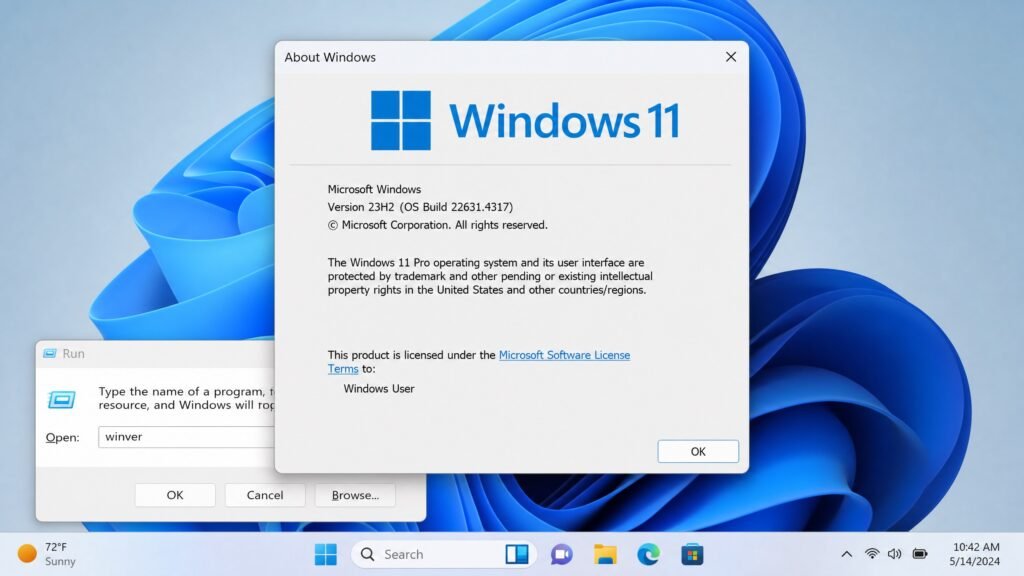
If you are wondering what windows do i have, the fastest answer is winver: press Windows key + R, type winver, press Enter. A small box shows your version — Windows 11 or Windows 10 — plus a version label like 24H2 and a build number. That is ten seconds and it is usually everything you came for.
It sounds like a beginner’s question until the moment it matters: installing software that needs a specific version, calling support, checking whether your PC still gets security updates, or buying an upgrade key and needing to know your starting point. Then everybody looks it up, beginners and IT veterans alike. This guide covers all seven methods, what every field actually means, and — the part most guides skip — what your answer means in 2026, because some results come with deadlines attached.
Table of Contents
- Method 1 — winver, the 10-second answer
- Method 2 — Settings, for edition and activation
- Method 3 — msinfo32, for the complete picture
- Methods 4 to 7 — Command Prompt, PowerShell, System Properties, dxdiag
- Which method should you actually use?
- What the fields mean
- 32-bit or 64-bit: the question hiding inside this one
- Which edition do I have, and does it matter?
- Reading your build number like a technician
- Is my Windows activated, and is it genuine?
- What your answer means, and what to do next
- Checking a PC that is not in front of you
- Five mistakes people make
- FAQ
What windows do i have? Method 1 — winver, the 10-second answer
Press Windows key + R together. A small Run box opens. Type winver and press Enter.
The winver box answers what windows do i have with your version at the top — “Windows 11”, “Windows 10” — followed by a version number like 24H2 or 22H2 and a build number in brackets.
This is the method to use when someone asks what windows do i have and you want the answer immediately. It works on every version of Windows going back many years, including ones where the Settings app does not exist.
What windows do i have? Method 2 — Settings, for edition and activation
Press Windows key + I to open Settings, then go to System → About at the bottom of the list.
This screen answers what windows do i have in more detail than winver: the edition (Home, Pro, Enterprise), the version, the build, whether Windows is 64-bit, and what processor and memory the machine has. It is the screen a support person means when they ask “what are you running?”
If the real question behind what windows do i have is which features you have access to, this is the screen that answers it — because edition, not version, decides things like BitLocker and Remote Desktop.
What windows do i have? Method 3 — msinfo32, the complete picture
For the fullest answer to what windows do i have, hold Windows key + R, type msinfo32, press Enter. The System Summary page is the most complete single view Windows offers of itself.
Read down the right-hand column:
- OS Name — version and edition together, so you see Windows 11 Pro rather than just Windows 11
- Version — the build number
- System Type — 64-bit or 32-bit
- System Manufacturer / Model — identifies the physical machine, which matters for drivers
- BIOS Mode — UEFI or Legacy
- Secure Boot State — On or Off
Those last two rows decide whether a machine can move to Windows 11. This is the screen to use when someone asks you for specifications: everything is on one page, and you can select rows and copy them straight into an email.
What windows do i have? Methods 4 to 7 — the specialist routes
Four more ways to answer what windows do i have, each better than winver in one situation.
Command Prompt — press the Windows key, type cmd, then run systeminfo for a full report including OS Name, OS Version, install date and total memory. For just the version, run ver instead. Fastest route when you are already in a terminal, and the output is text you can copy.
PowerShell — run Get-ComputerInfo | Select WindowsProductName, WindowsVersion for a structured answer that scripts easily across several machines. For one home PC it is more effort than winver for the same answer.
System Properties — right-click This PC in File Explorer, choose Properties. On Windows 10 and earlier this opens the old System window showing edition, system type and activation status. Works on every version of Windows going back many years, so it is the reliable choice on an unfamiliar machine.
dxdiag — Windows key + R, type dxdiag. Shows the OS, model, processor, memory and DirectX version, plus graphics hardware on the Display tab. If the question what windows do i have came from a game refusing to install, this is the screen the support forum will ask for.
Which method answers what windows do i have best?
| What you need | Best method | Under a minute |
|---|---|---|
| Just the version number, fast | winver | Yes |
| Version plus edition plus activation | Settings → System → About | Yes |
| Full specifications for a support ticket | msinfo32 | Yes |
| Copyable text output | systeminfo in Command Prompt | Yes |
| Several machines at once | PowerShell | No |
| Graphics or gaming problem | dxdiag | Yes |
| A very old or unfamiliar PC | System Properties | Yes |
What windows do i have: what the fields actually mean
| Field | Example | What it tells you |
|---|---|---|
| Edition | Windows 11 Pro | Product tier — decides BitLocker, Remote Desktop, domain join |
| Version | 24H2 | Yearly feature release (24H2 = second half of 2024) |
| OS build | 26100.2033 | Exact patch level — mostly for support calls |
| System type | 64-bit | Which software installers to download |
No Settings app? Identifying older Windows by sight
If Windows key + I opens nothing recognisable, you are likely on something older. A Start button opening full-screen colourful tiles is Windows 8 or 8.1. A round Start orb with a search box and glassy transparent window edges is Windows 7. Centred taskbar icons are Windows 11; left-aligned icons with a tiled Start menu are Windows 10. The winver command works on all of them.
32-bit or 64-bit: the question hiding inside this one
A good share of people searching what windows do i have are really being asked something more specific by a download page: is your Windows 32-bit or 64-bit? Getting this wrong is the commonest reason an installer refuses to run.
Open Settings → System → About and read System type. It says one of three things:
- 64-bit operating system, x64-based processor — 64-bit Windows on 64-bit hardware. Normal on any machine from the last fifteen years.
- 32-bit operating system, x64-based processor — your hardware could run 64-bit but a 32-bit version was installed, usually on an old machine upgraded in place many times.
- 32-bit operating system, x86-based processor — genuinely old hardware that cannot run 64-bit at all.
Why it matters more than it sounds
A 32-bit Windows cannot address more than about 4 GB of memory, and usable memory sits closer to 3.2 GB. If you have 8 GB installed and Windows reports a fraction as usable, that is almost always why — and adding memory will not help. 64-bit applications also will not install at all, and Windows 11 is 64-bit only, so it is a dead end for upgrading.
Moving from 32-bit to 64-bit is not a setting. There is no in-place switch; it needs a clean installation. The licence usually carries across, because a Windows licence covers the edition rather than the architecture. Our guide on creating a bootable USB covers the media step, and the Windows key not working guide covers activation afterwards.
Beyond what windows do i have: which edition, and does it matter?
The question what windows do i have has two halves, and confusing them causes real problems when buying software or joining a work network. Version is Windows 10 or Windows 11. Edition is Home, Pro, Enterprise or Education. Both appear on the Settings → System → About page.
| Edition | Who normally has it | Domain join | BitLocker | Remote Desktop host |
|---|---|---|---|---|
| Home | Most PCs bought from a shop | No | No | No |
| Pro | Business machines, enthusiast builds | Yes | Yes | Yes |
| Enterprise | Issued by company IT | Yes | Yes | Yes |
| Education | Issued by a school or university | Yes | Yes | Yes |
Three moments make the edition half of what windows do i have matter. If your workplace asks you to join the company domain and you have Home, you cannot — no setting enables it. If you want to reach your PC remotely from elsewhere, hosting a Remote Desktop session requires Pro. And if you need to encrypt the drive on a laptop that leaves the house, BitLocker is Pro too.
If you have Home and need Pro, you do not reinstall anything. Windows supports an in-place edition upgrade that keeps files and applications exactly where they are — enter a Pro key and the machine converts in minutes. Our comparison of Windows 11 Home vs Pro covers whether that is worth it, and the Windows 10 Home vs Pro guide does the same for the older version.
Equally, if you have Pro and only ever browse, write and watch things, you are not missing anything by not using its extra features.
Reading your build number like a technician
The number in the winver box is not decoration, and it is the half of what windows do i have that people ignore. A Windows version string has two parts: the version label (23H2, 24H2) tells you which half of which year that feature update was released, and the build number in brackets identifies the exact update level, with the digits after the full stop showing which monthly patch you are on.
The build matters in three situations: when a support article says a bug was fixed in a particular build, when software lists a minimum supported build, and when reporting a problem to a technician, because it is the first thing they ask. Two machines can both report Windows 11 and be a year apart in patches — the version name hides that, the build does not.
To check whether you are behind, open Settings → Windows Update and click Check for updates. Note that Windows sometimes holds a feature update back from specific hardware because of a known driver problem. That is not a fault, and forcing past the hold is how people create problems they then have to fix.
After what windows do i have: is it activated, and genuine?
Once you know what windows do i have, the natural follow-up is whether it is properly licensed. These are separate questions, and a machine can report a perfectly normal version while sitting on a licence that will not survive its next reinstall.
The quick check
Open Settings → System → Activation. One of three things appears:
- “Activated with a digital licence linked to your Microsoft account” — best outcome. The entitlement lives on Microsoft’s servers and follows your account, so reinstalling is painless.
- “Activated with a digital licence” — tied to this hardware. Survives a reinstall on the same machine, harder to move.
- “Windows is not activated” — there is a problem to solve.
The deeper check most people never run
Answering what windows do i have does not tell you what kind of licence you have. The activation screen tells you whether Windows accepted one. It does not tell you what kind, and that distinction is where trouble hides.
Open Command Prompt as administrator — Windows key, type cmd, right-click, Run as administrator — then run:
slmgr /dliA small window shows the licence description and the last five characters of the product key. Read the description carefully:
- RETAIL — a full retail licence, transferable to another machine and the most durable kind
- OEM — bonded to this motherboard permanently. Fine where it is, but it cannot legitimately move to a new computer
- VOLUME or KMS — a licence type intended for organisations. On a home machine this is a strong sign the key came from somewhere it should not have
Volume licences frequently reactivate against a server every 180 days, which is exactly how a machine that worked fine for months suddenly reports itself unlicensed. For more detail run slmgr /dlv, which adds the activation ID and, for volume licences, the renewal interval. If you see a renewal interval on a home PC, you now know why activation keeps lapsing.
What to do if the licence is not what it should be
If your what windows do i have check turns up a volume or KMS licence on a personal machine, the fix is straightforward: enter a proper retail licence. No reinstall, no data loss. Go to Settings → System → Activation → Change product key and enter the new one. The system re-licenses itself in place, usually in under a minute.
The reason to do this is practical rather than moral. An improperly licensed machine fails future upgrade paths, can lose activation without warning, and cannot be helped by Microsoft support. Putting it on a genuine Microsoft license key takes it off that list permanently. If you want the full explanation of how the resale market works before spending anything, our guide on whether it is safe to buy cheap Microsoft license keys is the honest version, including the parts that do not flatter our own industry.
What your answer means, and what to do next
This is the section that answers the reason you asked what windows do i have in the first place.
What windows do i have: Windows 11, activated
Nothing to do. You are on the current version with a valid licence. Keep Windows Update running and check the activation screen once a year out of habit. If the licence is a digital one not yet linked to a Microsoft account, linking it is ten minutes well spent.
If you are on Home and keep bumping into missing features like BitLocker, the Home vs Pro comparison shows what an upgrade key unlocks.
What windows do i have: Windows 10, activated
This needs a decision rather than an action. Windows 10 reached end of support in October 2025, and the consumer Extended Security Updates bridge runs out in October 2026 — very soon. After that, no security patches.
Check whether the machine can take Windows 11 using the msinfo32 rows described earlier — UEFI, Secure Boot, TPM 2.0, supported processor — plus tpm.msc for the TPM version. If it passes, upgrade before the deadline rather than during it. If it fails, our Windows 10 end of support guide lays out the realistic options, including the ones that do not involve buying a new computer, and the Windows 11 requirements guide walks through each check.
What windows do i have: Windows 7, 8 or 8.1
These are years past support and should not be used for banking, email or personal files. Windows 7 support ended in January 2020.
The upgrade path depends on the hardware: many machines from that era can run Windows 10, and some can run Windows 11. Our walkthrough on how to upgrade Windows 7 to Windows 10 covers the process including what happens to your files — and genuine Windows keys cost less than most people’s weekly lunch budget.
The screen says “Windows is not activated”
Different problem — that is licensing, not version. A watermark in the corner and locked personalisation settings mean Windows is running unlicensed. Deal with this before anything else, because an unactivated Windows also closes off future upgrade paths.
Sometimes it is a simple fix: a key that needs re-entering after a hardware change, or a digital licence that needs the account linked. Sometimes the machine was never properly licensed. Either way, a genuine key resolves it in about a minute through Settings, with no reinstall and no data loss — our activation guide covers every scenario.
Checking a PC that is not in front of you
Often the person asking what windows do i have is asking on someone else’s behalf — a parent on the phone, a colleague across an office, a machine in another room.
Over the phone. The instruction that works with anyone: hold the key with the Windows logo, tap R, let go, type winver, press Enter — then read me everything in the little box. One step, no menu navigation. Asking someone to open Settings and find About involves four or five steps where they can get lost.
Over the network. With administrative access on the same network, Get-ComputerInfo with a computer name parameter returns version details remotely. Needs remote management enabled — usually on for domain-joined business machines, usually off on home PCs. For a small office it is the fastest way to build an inventory before planning an upgrade.
Five mistakes people make answering what windows do i have
Confusing version with edition. Windows 11 is the version, Pro is the edition. Checking and seeing “Windows 11” answers only half the question.
Trusting the desktop appearance. Windows 10 can be themed to resemble Windows 11 and vice versa, and third-party Start menu replacements change everything. Read winver, not the screen.
Assuming the sticker is current. It records what shipped, not what is installed — and the sticker key is frequently not the key in use.
Reading the wrong number. If support asks for your build, they want the longer number in brackets, not the version label beside it.
Ignoring activation entirely. Knowing you have Windows 11 Pro tells you nothing about whether the licence behind it is durable. The slmgr check above takes twenty seconds.
Write it down once: the record worth keeping
Everybody looks up what windows do i have, gets their answer, and forgets it within a week. Five minutes now saves that loop forever.
Open msinfo32 and note six things per computer: version and edition, build number, system type, manufacturer and model, whether Secure Boot reads On, and whether activation reports a digital licence linked to your Microsoft account. Add the date, and keep it somewhere that is not only on the machine itself.
The value shows up when you call support and read answers instead of hunting for them, when you plan an upgrade and know instantly which machines qualify, and when a computer fails completely and you still have its licence details.
One habit worth the two minutes: link the digital licence to a Microsoft account under Settings → System → Activation. A licence tied only to hardware is bound to that motherboard — replace it and Windows deactivates with no straightforward way back. A licence linked to an account can be reclaimed through the activation troubleshooter in a couple of clicks.
If the answer you found was uncomfortable
Some people answer what windows do i have and find something unexpected — an unactivated system, a volume key on a home PC, or a version that stopped getting security updates. That is not a bad outcome; it is the same information you had before, except now you can act on it.
None of those situations requires a new computer, and most do not require reinstalling anything. An improperly licensed machine takes a genuine key through Settings and about a minute. Only genuinely old hardware failing multiple requirement checks needs a bigger conversation.
Genuine one-time-purchase Windows keys at Kymakers: legally sourced, tested before delivery, activated on Microsoft’s own servers, delivered by email within minutes, with a money-back guarantee.
- Windows 11 Pro product key: https://kymakers.com/product/microsoft-windows-11-pro-product-key/
- Windows 11 Home product key: https://kymakers.com/product/microsoft-windows-11-home-product-key/
- Windows 11 Home to Pro upgrade key — in-place edition change, files untouched: https://kymakers.com/product/windows-11-home-to-pro-upgrade-key/
- Windows 10 IoT Enterprise LTSC 2021 — security updates to January 2032, for hardware that cannot run Windows 11: https://kymakers.com/product/windows-10-iot-enterprise-ltsc-2021-product-key/
- Browse all Windows editions: https://kymakers.com/product-category/windows/
Microsoft’s own activation documentation is worth reading alongside this if your licence state is unclear.
What Windows do I have — FAQ
What windows do i have if winver will not open? Try Command Prompt: press the Windows key, type cmd, open it, then type ver and press Enter. If that also fails, right-click This PC in File Explorer and choose Properties, which works on every version of Windows ever shipped. A machine where none of these three work has a deeper problem than an unknown version.
In answering what windows do i have, how do I check 32-bit or 64-bit? Settings → System → About, and read “System type”. Virtually every PC from the last decade is 64-bit, but the field exists precisely because “virtually” is not “all”.
Beyond what windows do i have, how do I find my product key? For a licence embedded in the firmware by the manufacturer, run this in an administrator Command Prompt: wmic path softwarelicensingservice get OA3xOriginalProductKey. If a key appears, that is the OEM key in the motherboard. If nothing appears, your Windows is activated through a digital licence and there is no retrievable key — the entitlement lives on Microsoft’s servers. A digital licence is not a problem; it is the more convenient arrangement, because it survives reinstalls without you typing anything. Keys you bought are in your purchase email, so an archive folder is worth keeping.
Can I tell what windows do i have without turning the computer on? Not reliably. The sticker records what the machine originally shipped with, often several upgrades out of date. Nothing beats booting it and running winver.
Does knowing my Windows version tell me if I can upgrade to Windows 11? Only partly. Eligibility depends on hardware: TPM 2.0, Secure Boot, UEFI firmware, a supported processor, and enough memory and storage. Run msinfo32 for the firmware rows and tpm.msc for the TPM.
My PC says Windows 11 but everything looks like Windows 10. Why? Almost certainly a theme or third-party Start menu replacement. Trust winver over appearance. On a work machine, a corporate policy configuration may be restoring older interface behaviour deliberately.
Will checking what windows do i have change anything on my computer? No. Every method on this page is read-only. Winver, msinfo32, systeminfo, dxdiag and the slmgr licence check all report information without altering a setting, installing anything, or contacting Microsoft.
Someone is selling me a used PC — what windows do i have checks matter before paying? Run four checks in front of the seller. winver for version and build. The Settings activation page, to confirm it says activated. slmgr /dli in an administrator Command Prompt, to see whether the licence is retail, OEM or volume — a volume licence on a used home PC is a reason to walk away. And msinfo32, to confirm UEFI, Secure Boot available and a TPM, which decides whether it has any upgrade future. A seller who will not let you run four read-only commands has told you something useful.
Written by the KYMakers Technical Team. Technically reviewed by a Microsoft licensing specialist. Last updated: 2 August 2026. Sources: Microsoft Learn, Microsoft Support, Microsoft Lifecycle. KYMakers sells genuine, one-time-purchase Microsoft license keys with instant email delivery.