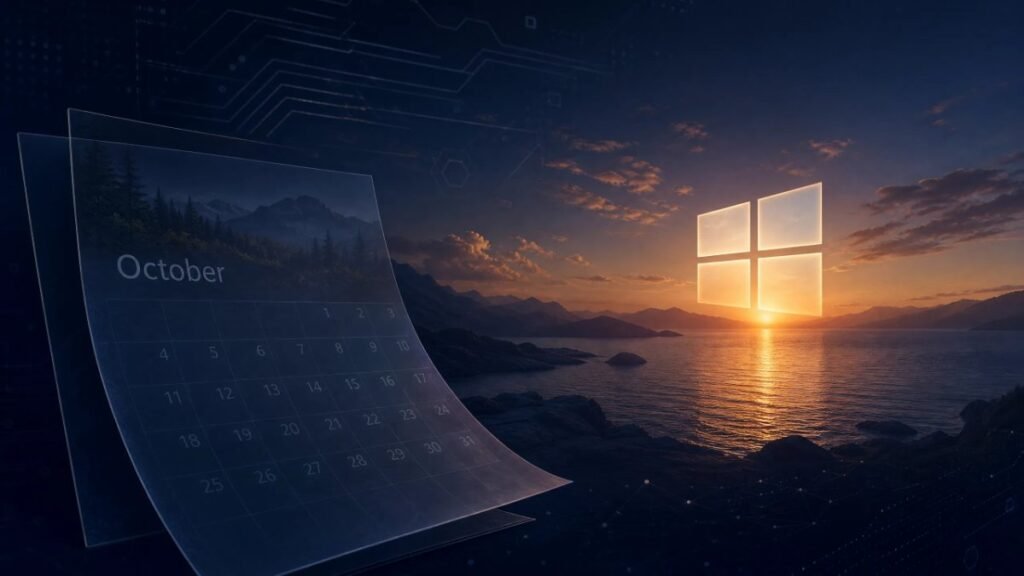
Windows 10 end of support happened on 14 October 2025 — but your PC did not explode. It kept working, exactly as promised. What you have been living in since is the grace year: Microsoft’s consumer Extended Security Updates (ESU) programme, which keeps security patches flowing until 13 October 2026.
That is a matter of weeks away. So the question is no longer “what happens when Windows 10 support ends” — it is “what am I doing before October.” Here are the four real options, without the panic, and an honest note about which one fits which machine.
Table of Contents
- What “end of support” really means
- The dates that matter now
- Option 1 — Upgrade to Windows 11 (free for most)
- Option 2 — The LTSC route for older hardware
- Option 3 — Paid ESU: a bridge, not a destination
- Option 4 — A newer PC
- The four options compared
- Check whether your PC qualifies for Windows 11
- Why the ESU enrol button sometimes never appears
- The unsupported-install workaround, honestly assessed
- What software drops Windows 10, and when
- Back up before any route
- The one thing not to do
- FAQ
Windows 10 end of support: what it really means
Nothing switches off at windows 10 end of support. Your PC boots, your files open, your printer still argues with you.
What stops is the monthly stream of security patches — and that matters more than it sounds, because Windows vulnerabilities get discovered constantly, and after windows 10 end of support they simply stay open. An unpatched, internet-connected PC gets riskier every single month. Slowly at first, then not.
Software follows the same slope. Over the next couple of years, browsers, banking tools and applications will one by one drop Windows 10 from their supported list, the way they eventually dropped Windows 7. You do not lose everything at once. You lose one application at a time, each loss arriving on the day you needed it.
The risk is also entirely about connection. A machine that never touches a network is not exposed by windows 10 end of support in any meaningful way — a point we come back to at the end, because it genuinely changes the advice for some people.
Windows 10 end of support: the dates that matter now
| Date | What happens |
|---|---|
| 14 October 2025 | Regular Windows 10 support ended — windows 10 end of support, already happened |
| 13 October 2026 | Consumer ESU ends — the current grace period expires |
| October 2028 | Business ESU ends; Microsoft 365 apps on Windows 10 stop getting security updates |
| 13 January 2032 | Windows 10 IoT Enterprise LTSC 2021 reaches end of support — the last Windows 10 standing |
One honest windows 10 end of support caveat on the second row. The consumer ESU bridge is widely documented as running to 13 October 2026, and that is the date to plan around. Microsoft’s own pages have at times shown a later figure, and enrolment terms differed in the European Economic Area following regulatory pressure. Treat 13 October 2026 as your deadline and verify against Microsoft’s current end-of-support page before relying on anything longer.
Option 1 — Upgrade to Windows 11 (free for most machines)
If your PC qualifies, this is the boring, correct answer to windows 10 end of support. The upgrade from an activated Windows 10 costs nothing, arrives through Windows Update, and keeps your files and applications in place.
The catch is the word “qualifies”. Windows 11 checks for TPM 2.0, Secure Boot, UEFI firmware and a 2018-or-newer processor — and plenty of machines that fail the check actually pass once a BIOS setting is flipped, because many ship with TPM and Secure Boot switched off from the factory. Our full walkthrough on Windows 11 requirements covers each check.
Building fresh, or setting up a PC that never had a licence? You will want a Windows 11 Pro key, and our Home vs Pro comparison if you are not sure which edition fits.
What the upgrade actually involves: back up, check for updates, accept the Windows 11 offer, and let it run for 30 to 90 minutes with a couple of restarts. Your files, applications and settings survive. If you dislike it within ten days, Settings → System → Recovery has a Go back button.
Option 2 — Your PC can’t run Windows 11: the LTSC route
This is the option most windows 10 end of support coverage skips entirely, and for owners of perfectly good older hardware it is the best one on the list.
Windows 10 IoT Enterprise LTSC 2021 is the long-servicing edition Microsoft builds for machines that need to run for a decade — and it receives security updates until 13 January 2032. That is more than five extra years of patched, supported Windows 10 on hardware Windows 11 refuses to touch.
There is a real bonus: LTSC ships without the bundled apps, widgets and suggestions, so it is noticeably lighter. Old laptops tend to feel faster after the switch, not slower.
The honest trade-offs, because they matter:
- It is a clean install, not an in-place upgrade. Back up first and plan for an evening of setup.
- The Microsoft Store is not included by default, so Store apps need another route.
- It never receives new features — that is the entire point of a long-servicing channel, but it means the interface you install is the interface you keep.
- Driver support depends on your hardware vendor continuing to publish Windows 10 drivers, which is generally fine for machines of that era.
For a 2013-to-2017 machine that runs well and fails the Windows 11 check, this is the route that buys the most years for the least money. You can find it here: Windows 10 IoT Enterprise LTSC 2021.
Option 3 — Paid ESU: a bridge, not a destination
For businesses, windows 10 end of support can be deferred: you can buy up to three years of extended updates, through October 2028, and for a fleet mid-migration that breathing room is exactly what it is for.
But note the shape of the deal: the cost doubles each year — roughly $61 per device for year one, then $122, then $244 — precisely so you do not settle in. Cumulatively that is over $400 per machine, which is often more than replacing the machine.
For home users, the consumer version of this bridge is the one ending in October, and it cannot be extended. Enrolment routes have included syncing your settings with Windows Backup, redeeming 1,000 Microsoft Rewards points, or a one-time payment of about $30 covering up to ten devices.
The right way to think about paid ESU: it is a way to finish a migration that is already underway, not an alternative to one.
Option 4 — A newer PC
Sometimes windows 10 end of support just confirms the machine is done. A laptop from 2014 owes you nothing.
Any PC from roughly 2019 onward clears the Windows 11 bar, refurbished ones included — and a refurbished business desktop is frequently the cheapest honest answer to windows 10 end of support for a machine that is genuinely past it.
Just remember that a “no OS” or wiped machine needs a genuine Windows licence. Our Windows 11 keys arrive by email in minutes, and activation is a five-minute job with the step-by-step guide.
Windows 10 end of support: the four options compared
| Option | Cost | Patched until | Best for |
|---|---|---|---|
| Upgrade to Windows 11 | Free (existing licence) | 2031+ | Any PC that passes the checks |
| LTSC 2021 | One-time licence | January 2032 | Good hardware that fails Windows 11 |
| Consumer ESU | Free routes or ~$30 | October 2026 only | Buying weeks, not years |
| Business ESU | $61 → $122 → $244/device | October 2028 | Fleets mid-migration |
| New or refurbished PC | Hardware + licence | 2031+ | Machines genuinely past it |
| Do nothing (online PC) | Free | Nothing after October | Not recommended |
| Do nothing (offline PC) | Free | Not applicable | Genuinely fine |
Read that table by your own machine, not in aggregate. Most people are in row one and do not realise it, because they read a 2021 article saying their CPU was unsupported and never re-checked after a firmware update.
Check whether your PC qualifies for Windows 11
Five minutes, using tools already on your PC. Do this before you decide anything about windows 10 end of support, because it eliminates three of the four options for most people.
Run the official check. Microsoft’s PC Health Check app gives a verdict and names the specific failing requirement, which is the part you need.
Check the firmware rows manually. Windows key + R, type msinfo32. Look for BIOS Mode — it needs to read UEFI, not Legacy — and Secure Boot State, which needs to read On.
Check the TPM. Windows key + R, type tpm.msc. The panel tells you whether a TPM exists and which specification version it reports. 2.0 is the one Windows 11 wants; 1.2 does not qualify.
If TPM or Secure Boot reads off or absent: do not conclude the machine fails. Restart into your BIOS/UEFI setup (usually F2, F10 or Delete during boot) and look for settings named TPM, PTT (Intel Platform Trust Technology), fTPM (AMD), or Secure Boot. On a great many 2016-to-2018 machines these exist and are simply disabled. Switching them on converts a “fails” verdict into a free upgrade.
If the processor is the failing item: that one cannot be fixed by a setting, and Option 2 or Option 4 is your route.
Not sure which Windows or edition you are running to begin with? Our guide to checking which Windows you have covers it in thirty seconds.
Why the ESU enrol button sometimes never appears
A common and genuinely confusing problem in the months around windows 10 end of support.
The enrolment option appears in Settings → Update & Security → Windows Update, but only when several conditions are met at once. The machine must be on Windows 10 version 22H2 — check with winver — and fully patched, because enrolment shipped through cumulative updates. It must be activated with a genuine licence. And you need to be signed in with a Microsoft account holding administrator rights; local-account-only machines were not offered enrolment.
If all of that is true and the option still does not appear, install every pending update, restart, and check again — the enrolment rollout was staged rather than simultaneous.
If you are reading this close to or after October 2026, the honest answer is that consumer enrolment is no longer the useful path, and one of the other three options is where your evening should go.
The unsupported-install workaround, honestly assessed
Faced with windows 10 end of support, many people find registry edits and third-party tools that install Windows 11 on hardware failing the checks. They work, in the narrow sense that Windows 11 boots afterwards.
Here is the honest assessment, because pretending the workaround does not exist would be useless and recommending it would be irresponsible.
Microsoft states plainly that unsupported installations are not entitled to receive updates, and has shown warnings and, in some builds, withheld feature updates from such machines. You are trading a documented support relationship for an undocumented one. On a test machine or a hobby build, that may be an acceptable trade. On the computer that handles your email and your banking, it is the opposite of what you were trying to achieve by escaping windows 10 end of support in the first place.
LTSC 2021 is the supported version of the same wish — modern-enough Windows, on old hardware, patched to 2032, with no workarounds and no warnings.
What software drops Windows 10 after end of support, and when
The security angle gets all the attention, but for most people the first real inconvenience after windows 10 end of support is software.
Microsoft 365 apps on Windows 10 stop receiving security updates in October 2028, per Microsoft’s own guidance. They keep running before and after that; the patching is what ends.
Browsers typically continue for a year or two past an OS end-of-support date, then freeze. When your browser stops updating, that is the moment web-based banking and shopping become genuinely risky rather than theoretically risky.
Security software vendors set their own schedules, and an antivirus that no longer supports your OS is worse than useless because it creates false confidence.
Games and creative applications follow the installed base. Expect “Windows 11 or later” in system requirements to become normal across 2027 and 2028.
None of this happens in October. All of it happens over the following two years, which is why the migration is worth planning rather than deferring.
Back up before any windows 10 end of support route
Every windows 10 end of support option except the free in-place upgrade involves a clean install, and even the upgrade deserves a backup.
Copy your documents, photos and anything irreplaceable to an external drive or cloud storage. Note your browser bookmarks and any software licence keys sitting in old emails. If you use a local email client, find out where its data lives before you wipe anything.
For the clean-install routes you will need installation media, which our guide to creating a bootable Windows USB walks through. And if activation misbehaves afterwards, our guide on what to do when a Windows key is not working covers the error codes in order.
Windows 10 end of support: the one thing not to do
Do not ride an unpatched Windows 10 into 2027 on the open internet and hope for the best. It will feel fine — right up until it does not.
If the PC handles email, banking, shopping or work files, pick any option above. If your organisation has compliance obligations, running an unsupported OS is difficult to defend to an auditor and increasingly difficult to defend to a cyber-insurer.
The genuine exception: an offline workshop, lab or media machine that never touches a network can keep running Windows 10 for years. The risk lives in the connection, not the calendar. Be honest with yourself about which category your machine is in — “mostly offline” is not offline.
Windows 10 end of support: act now or wait?
Act. Windows 10 end of support is the rare technology decision with an actual deadline printed on it: 13 October 2026.
Waiting does not improve any option. The free Windows 11 upgrade does not get freer, LTSC does not get longer, and unpatched time only accumulates. Support queues and forum traffic also spike when a deadline lands, so the same upgrade that takes an afternoon in a quiet month becomes a frustrating weekend during the rush.
Whichever path fits, it takes one evening. Pick the evening.
Get a genuine licence at Kymakers
Genuine one-time-purchase keys for every windows 10 end of support route: legally sourced, tested before delivery, activated on Microsoft’s own servers, delivered by email within minutes, with a money-back guarantee.
- Windows 10 IoT Enterprise LTSC 2021 — patched to January 2032, the best answer for hardware that fails the Windows 11 check: https://kymakers.com/product/windows-10-iot-enterprise-ltsc-2021-product-key/
- Windows 11 Pro product key: https://kymakers.com/product/microsoft-windows-11-pro-product-key/
- Windows 11 Home product key: https://kymakers.com/product/microsoft-windows-11-home-product-key/
- Browse all Windows editions: https://kymakers.com/product-category/windows/
To be clear about when you need us and when you do not: if your PC passes the Windows 11 check and already runs an activated Windows 10, the upgrade is free and you need nothing from us. We would rather tell you that than sell you a key you already own. A licence matters when the machine has no genuine Windows, when you are moving to LTSC, or when you are setting up a wiped or refurbished PC. Microsoft’s own end-of-support page is the source to check for anything official.
Windows 10 end of support — FAQ
Will my PC stop working at windows 10 end of support in October 2026?
No. It keeps running — it just stops receiving security patches once consumer ESU ends. The risk is gradual exposure, not a shutdown.
After windows 10 end of support, can I still activate Windows 10 with a new key?
Yes. Windows 10 keys still activate normally, and a genuine Windows 10 licence also entitles the same PC to the free Windows 11 upgrade — which makes it a sensible purchase in 2026 for a machine heading to Windows 11 anyway.
Is the free upgrade to Windows 11 still available after windows 10 end of support?
Yes. Microsoft has kept it open well past every rumoured cutoff. If your PC passes the requirements check, Windows Update offers it at no cost.
Is LTSC legitimate for a home user after windows 10 end of support?
Completely. It is a genuine Microsoft edition with a genuine licence — built for industry, but nothing stops you running it at home. It installs like any Windows, minus the clutter, and stays patched into 2032.
Why does my PC fail the Windows 11 check when it seems fast enough?
Almost always TPM 2.0 or Secure Boot switched off in firmware rather than absent — check tpm.msc and msinfo32, then look in your BIOS for TPM, PTT, fTPM or Secure Boot. If the processor is the failing item, that cannot be changed by a setting.
Can I extend consumer ESU past October 2026?
No. The consumer bridge is a one-year programme and cannot be extended. Business ESU runs to October 2028 but is per-device, paid, and doubles in price each year.
Should I install Windows 11 on unsupported hardware using a workaround?
Not on a machine you depend on. Microsoft states unsupported installations are not entitled to updates, which defeats the reason you were escaping windows 10 end of support. LTSC 2021 is the supported way to get patched Windows on old hardware.
I only use my PC offline — do I need to do anything?
Genuinely, no. The risk from windows 10 end of support lives in the network connection. An air-gapped workshop, lab or media machine can run Windows 10 for years. Just be honest about whether it is truly offline.
What happens to Microsoft Office after windows 10 end of support?
Microsoft 365 apps on Windows 10 stop receiving security updates in October 2028. Perpetual Office versions follow their own lifecycle dates independently of the operating system.
Written by the KYMakers Technical Team. Technically reviewed by a Microsoft licensing specialist. Last updated: 2 August 2026. Sources: Microsoft Lifecycle, Microsoft Support. KYMakers sells genuine, one-time-purchase Microsoft license keys with instant email delivery.